The Bauer College of Business at University of Houston has a deep history of Experiential Project-based Learning and is unique for its large-scale third-year course that involves a live client-based project. This course has been extremely popular with industry partners, demonstrating that there can be tremendous value for employers earlier in the curriculum than the traditional senior year capstone. In this spotlight, we do a Q&A with Troy Hopkins, Bauer’s Director of Experiential Learning to learn more about how this program works.
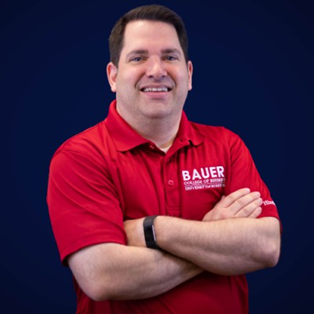
Troy Hopkins
Director of Experiential Learning
Bauer College of Business
University of Houston
Tell us about Experiential Project-Based Learning at Bauer College of Business
At Bauer, this isn’t a capstone-only model. We’ve embedded live, client-based projects into the core curriculum, starting in a (third-year) required course. Companies and nonprofits submit project ideas, and my team centrally sources and vets projects, carefully scopes them, and aligns them with course objectives. I have over 1200 students in teams of 8 each semester, so these specialized projects do run out. Students have to bid on them, and EduSourced is used for that process. Students who cannot work on those special projects are part of a business case competition for the semester. Every student works on an experiential project before they declare their official major in Business. Later classes within the major and graduate-level courses involve project-based learning, and by then, students are familiar with working in groups, using EduSourced with clients and/or mentors, and can focus on higher-level critical thinking for the project.
How have you made this work earlier in the curriculum?
We redesigned the model for that stage. The projects are tightly scoped and highly structured. Clear deliverables, clear timelines, and defined client and mentor contacts. We also explicitly teach the professional skills students need, like how to run a client meeting or structure a recommendation. People underestimate college sophomores. They can handle ambiguity. They just need guardrails.
Are there advantages to doing live projects before senior year?
Early exposure helps shape identity and emphasizes teamwork. Students start seeing themselves as business professionals, and that changes how they engage in class. When a client problem is on the table, frameworks feel necessary, not abstract. By senior year, they are integrating knowledge instead of encountering real-world complexity for the first time.
How have you managed faculty capacity in such a large program?
We’ve reduced friction as much as possible by building frameworks and creating guidelines.
Faculty are usually good at sourcing their own projects or managing clients, but may lack the structure or logistics to scale it for a class or several sections. EduSourced handles onboarding, vetting, and the logistics of signing up for projects. That lowers the barrier to participation for outside organizations. When faculty see that the projects reinforce course objectives and do not create chaos, buy-in increases.
What would you suggest to a school that relies only on faculty networks for sourcing?
Faculty networks are valuable, and adding a system that allows contacts to submit projects creates a sustainable structure. Through a defined project submission form, you help clients understand what a good project structure starts with. Scale requires infrastructure. If every project depends on one faculty member’s personal relationship, it’s difficult to grow or sustain the model. In addition, the same contacts and project problems can lead to the passing down of information (cheating). The sweet spot is a partnership with faculty, not replacement.
Is there anything you’d like to write to share on this to detail how Bauer has institutionalized project sourcing and the role your career services office plays?
Most career service offices we talk to are working with companies that have moved away from first-round on-campus interviews to video platforms, decreasing on-campus engagement. The request we are seeing more frequently from at least half of the mid-sized and large companies we work with is to ‘get into the classroom’. This can be difficult, as Career Services and Experiential Learning are not usually directly connected to faculty in the areas they cover, and curriculum planning with faculty can be a tough obstacle to overcome.
This is where project-based experiential learning comes in. Many faculty use cases as a capstone to showcase learning objectives. For these cases, faculty may utilize open-access case studies, obtain them from textbook publishers, or create the cases themselves.
Using EduSourced, we have been able to get companies, nonprofits, and government entities to submit cases for student teams to work on, creating a direct relationship between the organization and the student teams. In addition, we have worked with large organizations to sponsor large-scale case competitions within classes that can serve over 1000 students in a single semester.
Can you detail how you use EduSourced for Experiential Project-based Learning at Bauer?
We use EduSourced to run real project-based learning with nonprofits, government partners, and companies, and it has completely changed how we scale experiential education. Whether I am working with a professor who has a graduate class of 5 students or coordinating projects for my own course across 1,200+ students in three different sections, the platform keeps teams organized, clients aligned with teams, coaches up to date with assignments they will be assisting with, and faculty focused on mentoring rather than hours of administration. It gives structure to complex, live projects without getting in the way of learning. If you care about delivering authentic, high-impact experiences at scale, EduSourced makes it possible.