Overview
Managing large-scale capstone programs requires balancing academic rigor, industry partnerships, student engagement, and administrative efficiency. Adding multidisciplinary or cross-department projects magnifies this challenge, but it also provides students with a more authentic, real-world learning experience and enables schools to support industry-sponsored projects that don’t fit within a single academic department.
San Diego State University has built a nationally recognized capstone experience that not only connects students with industry-sponsored projects but also increasingly emphasizes collaboration across engineering disciplines. To support this, SDSU implemented EduSourced as its capstone management platform, helping streamline administration, support collaboration across departments, and create a more organized experience for students, faculty, and industry sponsors. SDSU’s success demonstrates how the right technology can support experiential learning programs, foster multidisciplinary teamwork, reduce administrative burden, and enhance educational outcomes.
Q: Tell us about capstone at San Diego State University
In the SDSU Senior Design Capstone Program, students learn how to work effectively in teams, apply conceptual design methods, and take a project from a customer need to an operational system. At the end of the program, students are required to demonstrate the functionality of their design as set forth in a requirements document.
What distinguishes the SDSU Senior Design Capstone program is its comprehensive integration of industry-standard project management processes and systems engineering tools with cross-disciplinary collaboration. SDSU’s balanced approach emphasizes both product and process, preparing students for the multifaceted challenges they will encounter in industry. The SDSU Capstone program covers two semesters with the first semester focused on project definition, research, design and analysis coupled with the building and testing of prototypes (at the subsystem and overall system level as applicable).
Both the Electrical and Computer Engineering (ECE) and Mechanical Engineering (ME) Senior Design Capstone courses are also distinguished from many other university engineering capstone programs by incorporating the university’s Graduation Writing Assessment Requirement (GWAR) into the first semester of the two-semester sequence. The GWAR is a mandatory graduation requirement that assesses and certifies students’ proficiency in upper-division written communication. As part of this requirement, ECE and ME students work in teams to develop a series of formal technical documents, such as a Project Management Plan, System Description, Requirements, and Validation document, a Prototype Activity Report, and a Final Design Report.
The first semester concludes with a Critical Design Review (CDR) presentation. The purpose of the CDR is to demonstrate to stakeholders that the proposed project is technically and logistically feasible and that the design can proceed with acceptable levels of risk. The presentation is delivered to an audience that may include faculty members, technical staff, fellow students, and sponsor representatives responsible for project funding decisions. During the CDR, the audience evaluates both the feasibility of the proposed project and the team’s capability to execute it successfully. This process provides students with valuable experience communicating complex technical information to diverse audiences. Developing this communication ability supports one of the core student learning outcomes required for accreditation by ABET (the Accreditation Board for Engineering and Technology).
The second semester of the program advances the teams to full system fabrication, testing, and rework as needed, along with system performance verification culminating in system delivery to the project sponsor. A final design report and presentation is provided by the student teams at the end of the program and the students display their work at SDSU’s annual “Design Day” event which is open to the public and typically has over 2,500 attendees.

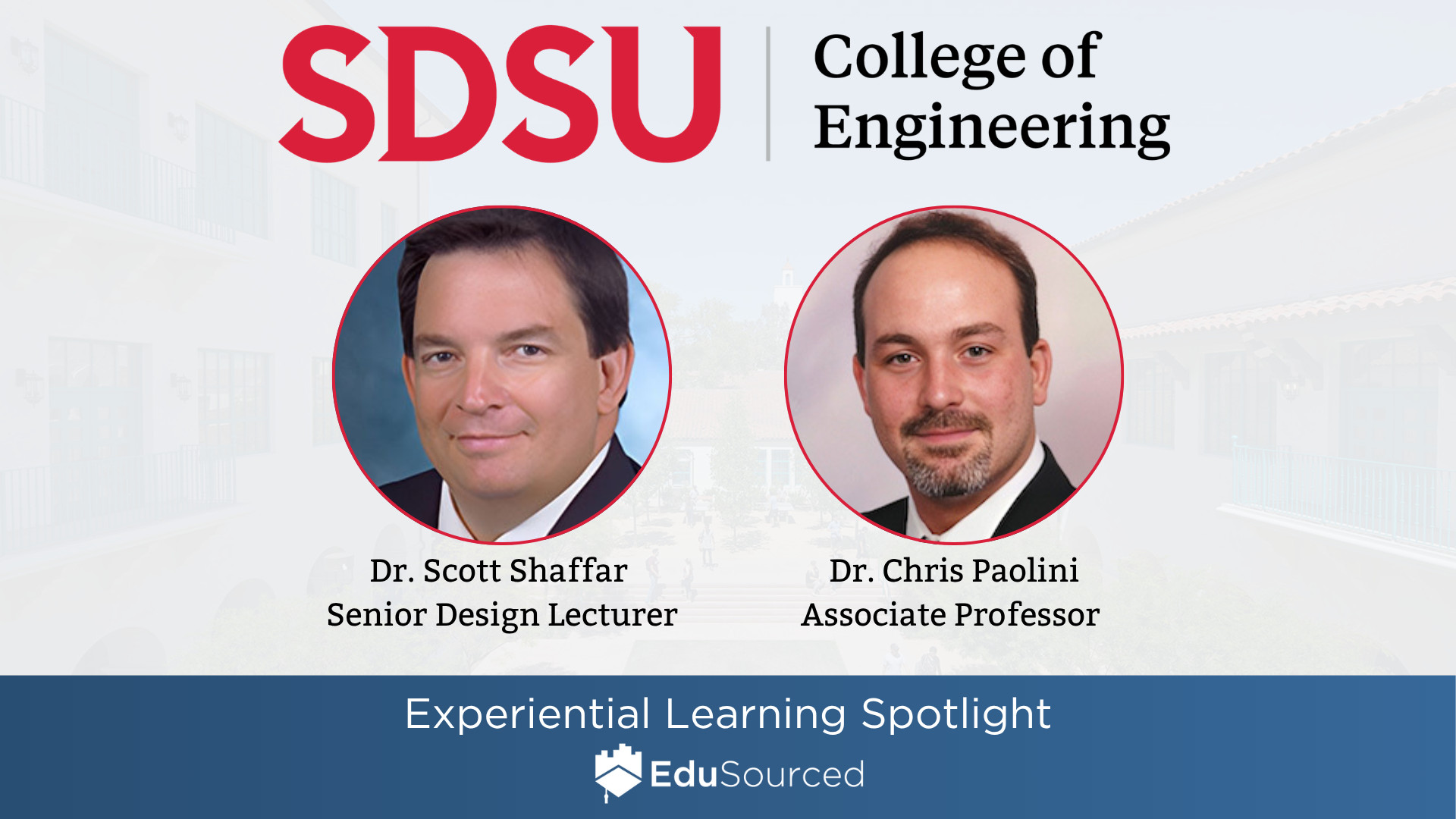
Dr. Scott Shaffar
Senior Design Lecturer
San Diego State University

Dr. Chris Paolini
Associate Professor
San Diego State University
Multidisciplinary Capstone Projects
Q: Roughly what proportion of your projects are multidisciplinary?
For the ME department, roughly 50% of the projects are multidisciplinary including Electrical and Computer Engineering (ECE), Aerospace Engineering (AE) and Civil, Construction and Environmental Engineering (CCEE).
Q: Your program received substantial local media attention just this spring. Do you expect this to impact project recruitment and do you have any advice for capstone faculty or staff seeking press coverage for their program?
Not directly. My prior experience is that perhaps one project could come from it. That said, the news article is useful as an example of what we can accomplish – this is especially useful when talking to potential new project sponsors. For advice to faculty or staff, seek out and form a relationship with your university communications/media relations group. Once you make contact, share information about your program and projects, especially those that would be of interest to your local community.
Q: What is the origin of SDSU doing multidisciplinary capstone?
SDSU first established joint Mechanical Engineering and Electrical and Computer Engineering Senior Design Capstone projects during the 2019 to 2020 academic year. The fundamental reason for this was that industry projects are typically multi-disciplined, and our goal was to prepare engineering students to work in such teams.
Q: You implemented EduSourced this past academic year in your ME department and, it’s in the process of being rolled out to other departments now. What has been the value of EduSourced for your program?
First, it helps reduce the administrative burden for Senior Design Capstone faculty. Much of what we did manually or with simple Office tools is now completed using the EduSourced platform – including project submissions, student project bidding and team formation, student peer surveys and sponsor surveys. Second, it serves as a great way to interface with sponsors from the project submission phase all the way through project completion and closeout. Third, it provides a sustaining record of projects, sponsors and teams. Fourth, it provides a collaborative platform for project sponsors and their teams.
Advice and Lessons Learned
Q: For schools that are interested in offering multidisciplinary capstone, what advice would you give?
Since establishing joint projects, interest for these projects has grown including students, instructors, and project sponsors. Some industrial sponsors have now made it clear that they are primarily only interested in joint teams. It is important for instructors to understand the possible delineation of design areas. Given the differences, students often go about their work without involving the students who are not in their respective engineering department. System design solutions, however, include items such as user interfaces and control systems which are joint tasks wherein students must work closely together regardless of their major. Consequently, students must be encouraged by their instructor to support each other, including working in each other’s labs.
Q: What are the advantages of multidisciplinary (for students, project clients, or anything else)?
The expansion of cross-disciplinary projects has enhanced the educational experience and prepared students for complex, multidisciplinary challenges. This has also translated to competitive advantages for students seeking employment in industry. Project clients prefer joint projects, largely due to the nature of real-world engineering challenges.
Q: Are there any particular challenges you’ve run into with this model?
As instructors, a key challenge is to maintain the focus of the individual courses while supporting joint student teams working toward a common goal. While the synergies between disciplines are obvious, the differences are more subtle. One key difference is the scale of the components that each discipline works with. A further challenge is fully integrating assignments for joint teams due to the nature of the technical tasks.
Q: Cross-department capstone organization is sometimes led by school leadership, sometimes occurs organically through faculty collaboration and sometimes remains entirely siloed. Your program seems to have followed the organic cross-department path. Do you recommend this approach and do you have any thoughts on institutionalizing these joint projects that have been so impactful for your students and employers?
The establishment of interdisciplinary projects and thus cross-department student teams took us a few years, starting with a small effort between two departments (ME and ECE). The number of joint projects grew over time and became visible to the entire College via our annual “Design Day” event whereby students showcase their work. The very booklet for Design Day had to be changed to include a new section for the joint projects. Eventually, the other departments took notice and so did their students who in turn asked for joint projects. We then expanded our joint projects to include the other departments. Industry project sponsors also play a role in this, as they now prefer joint projects. Yes, this approach is recommended as faculty and students need to see the value, and that will take time. The administrative complexity does increase for cross-department projects, and the faculty will not support the additional work unless the value proposition is proven.
Projects can be submitted to SDSU’s capstone here.